I couldn't get my post to work as a comment, so I just put it here.
Right away I have to state that I am not a video game player. My boyfriend is and I leave the room every time he starts to play. But sometimes he stops me and tells me what his task is in the game. I have been shocked at the different historical aspects that are part os what I call his "blood and guts games". In one such game there is a character that must face Aries, the god of war. I remember the test that I took in high school where I had to memorize the different Roman and Greek gods and now I have no recollection of who they are, but my boyfriend knows them all from his game.
All this to say that I think that video games can and do cover some content areas that have historically been a part of traditional scholarship in an interactive, memorable, and exciting way. My boyfriend's engagement with the material is much greater than mine and his recollection is instantaneous.
Buckingham and Burn, in their article entitled Game Literacy in Theory and in Practice, place additional value on gaming not as a teacher of curricula or to re-engage learners, but as a valuable entity unto itself as a cultural medium. As Buckingham and Burn describe gaming literacy, I am definitely illiterate. I find other ways to play that have not included the video game scene. So I wonder how prevalent gaming literacy is currently and how popular it will become. Is it a valuable literacy to teach in the classroom?
Wednesday, March 3, 2010

Video Games and Literacy: More Than Meets the Eye
I've been doing a lot of thinking about video games and literacy, and I just want to put a couple of ideas and questions out to the group to both extend my own thinking, and maybe to frame the conversation a bit, moving it outside of the "video games are not as good as books" argument that I hear a lot.
First, I think that it's really important to define terms in a discussion like this one. One central term is literacy. Are we thinking of literacy as being able to decode symbols to create meaning (functional literacy) or are talking about literacy as the ability to understand, critique, and question text, media, or other things interacted with (critical literacy)? Or are we saying the ability to read and comprehend books (print literacy)? Another central term is video game. Is the discussion around "mini" games such as Tetris, MarioKart, BrainAge, or around "complex" games, games that require players to take on a new identity, play for more than 10-100 hours to complete the game, problem solve and face consequences for their decisions, such as Final Fantasy, Spore, Sims, DragonQuest, etc? (BTW, I borrowed these terms from Marc Prensky, who talks about them in his book Don't Bother Me Mom, I'm Learning.)
From the reading and studying that I have done, I think that complex games can probably improve critical and perhaps even functional literacy. James Paul Gee makes a case for this in What Video Games Have to Teach Us About Learning and Literacy, in which he argues that educators can study games to observe extremely effective teaching techniques. (Whatever you think of the content of games, they are very good at both motivating people to keep playing them, and teaching them an internalized implicit set of rules so that they can understand and play the game.) One example of Gee's arguments about how games can support even print literacy (there are many, and I really encourage you to check out his book if you are interested!) is that games teach players "to learn about and come to appreciate interrelations within and across multiple sign systems (images, words, actions, symbols, artifacts, etc.) as a complex system, [which is] core to the learning experience." To paraphrase, learning to read at its most basic is really a process of learning how to decode and understand a symbol set. While games may be teaching players to understand a different kind of symbol set (not the English language), they are honing the same underlying skill.
In addition games provide a unique chance for players to immerse themselves within narrative structures, becoming part of the story creation itself. Some games have better stories than others, true, but they also do something that books can't (even Choose-Your-Own-Adventure books!): they give the "reader" / player agency and power over shaping the story line.
Finally, I'm borrowing from Steven Johnson's book Everything Bad Is Good for You to make this little chart about the differences between books and video games. While books do many things very well, and we have invested them in Western culture for hundreds if not thousands of years because of the things they do well, video games do other things very well, and I don't know that it has to be an either/or dichotomy. Maybe print literacy is not the main benefit of video games, and maybe it shouldn't be. But perhaps there are other, just as valuable, skill sets that video games have to offer. Take a look and see what you think.

First, I think that it's really important to define terms in a discussion like this one. One central term is literacy. Are we thinking of literacy as being able to decode symbols to create meaning (functional literacy) or are talking about literacy as the ability to understand, critique, and question text, media, or other things interacted with (critical literacy)? Or are we saying the ability to read and comprehend books (print literacy)? Another central term is video game. Is the discussion around "mini" games such as Tetris, MarioKart, BrainAge, or around "complex" games, games that require players to take on a new identity, play for more than 10-100 hours to complete the game, problem solve and face consequences for their decisions, such as Final Fantasy, Spore, Sims, DragonQuest, etc? (BTW, I borrowed these terms from Marc Prensky, who talks about them in his book Don't Bother Me Mom, I'm Learning.)
From the reading and studying that I have done, I think that complex games can probably improve critical and perhaps even functional literacy. James Paul Gee makes a case for this in What Video Games Have to Teach Us About Learning and Literacy, in which he argues that educators can study games to observe extremely effective teaching techniques. (Whatever you think of the content of games, they are very good at both motivating people to keep playing them, and teaching them an internalized implicit set of rules so that they can understand and play the game.) One example of Gee's arguments about how games can support even print literacy (there are many, and I really encourage you to check out his book if you are interested!) is that games teach players "to learn about and come to appreciate interrelations within and across multiple sign systems (images, words, actions, symbols, artifacts, etc.) as a complex system, [which is] core to the learning experience." To paraphrase, learning to read at its most basic is really a process of learning how to decode and understand a symbol set. While games may be teaching players to understand a different kind of symbol set (not the English language), they are honing the same underlying skill.
In addition games provide a unique chance for players to immerse themselves within narrative structures, becoming part of the story creation itself. Some games have better stories than others, true, but they also do something that books can't (even Choose-Your-Own-Adventure books!): they give the "reader" / player agency and power over shaping the story line.
Finally, I'm borrowing from Steven Johnson's book Everything Bad Is Good for You to make this little chart about the differences between books and video games. While books do many things very well, and we have invested them in Western culture for hundreds if not thousands of years because of the things they do well, video games do other things very well, and I don't know that it has to be an either/or dichotomy. Maybe print literacy is not the main benefit of video games, and maybe it shouldn't be. But perhaps there are other, just as valuable, skill sets that video games have to offer. Take a look and see what you think.

Monday, March 1, 2010
Civilization III and the Classroom
Gaming is something I know next to nothing about, I’ll admit that. I was a mother by the time Atari came out and was introduced to the industry when my sons got one from their grandmother for Christmas. They loved it and gaming is still the favorite past time of both of my grown sons.
My elder son, Tim, was a new teacher in 2005 and as a gamer, he, and Jim McIntosh, another social studies teacher at Roosevelt High School in Chicago, decided to introduce Civilization to their World Civilizations class as described in MTV’s article http://tiny.cc/SEmgz.
Tim and Jim wrote Firaxis, the creator of Civilization III and asked for a donation of the game for their class. The company sent 25 copies of the game so that the entire computer lab could be loaded up. It was Student Development Day, a monthly day in which the students take a break from literature and math and study things that enrich their lives in other ways. Teachers were supposed to teach something that they themselves were good at and/ or about which they were passionate. Gaming was a natural for Meegan and McIntosh.
"I think one of the things video games provide students is a sense of an immediate reward," Meegan said. He wanted to tap into that. "I want to use it as a tool for them to discover more about what really happened and who these people really are," he explained. Meegan said the game can help illuminate such concepts as guns vs. butter, supply and demand, and the pros and cons of military strength.
I agree with Tim in that the most valuable part of this experience is in learning about supply and demand, but Buckingham piqued my interest in his discussion of gaming as a medium in and of itself because the user has to interact with it and that that creates a literate gamer.
Is it true that everything I interact with makes me more literate, more knowledgeable? That is what I think of when I think of literacy. Knowledge – both in knowing how to do something and in understanding what it means, or could mean, either to one personally or to the neighborhood, or to the world at large. Are video games really making us more literate? I would have to vote no, not by what I have seen so far. Sure, the storyline of a game like Civilization could have value in a classroom but to say that gaming brings a literacy all its own Is really stretching it, in my opinion.
That is not to say that gaming does not have a place in school or in the library. I just argue that it is not making our children more literate. Additionally, I think that the time today’s children and teens spend with video games is detrimental to their literacy. Interacting with a character on a TV screen is not as valuable as interacting physically with another in play or sports, nor is it the same thing as broadening horizons with a book.
My elder son, Tim, was a new teacher in 2005 and as a gamer, he, and Jim McIntosh, another social studies teacher at Roosevelt High School in Chicago, decided to introduce Civilization to their World Civilizations class as described in MTV’s article http://tiny.cc/SEmgz.
Tim and Jim wrote Firaxis, the creator of Civilization III and asked for a donation of the game for their class. The company sent 25 copies of the game so that the entire computer lab could be loaded up. It was Student Development Day, a monthly day in which the students take a break from literature and math and study things that enrich their lives in other ways. Teachers were supposed to teach something that they themselves were good at and/ or about which they were passionate. Gaming was a natural for Meegan and McIntosh.
"I think one of the things video games provide students is a sense of an immediate reward," Meegan said. He wanted to tap into that. "I want to use it as a tool for them to discover more about what really happened and who these people really are," he explained. Meegan said the game can help illuminate such concepts as guns vs. butter, supply and demand, and the pros and cons of military strength.
I agree with Tim in that the most valuable part of this experience is in learning about supply and demand, but Buckingham piqued my interest in his discussion of gaming as a medium in and of itself because the user has to interact with it and that that creates a literate gamer.
Is it true that everything I interact with makes me more literate, more knowledgeable? That is what I think of when I think of literacy. Knowledge – both in knowing how to do something and in understanding what it means, or could mean, either to one personally or to the neighborhood, or to the world at large. Are video games really making us more literate? I would have to vote no, not by what I have seen so far. Sure, the storyline of a game like Civilization could have value in a classroom but to say that gaming brings a literacy all its own Is really stretching it, in my opinion.
That is not to say that gaming does not have a place in school or in the library. I just argue that it is not making our children more literate. Additionally, I think that the time today’s children and teens spend with video games is detrimental to their literacy. Interacting with a character on a TV screen is not as valuable as interacting physically with another in play or sports, nor is it the same thing as broadening horizons with a book.
His and Hers Gaming, Facebook Style
I must admit that I play more Facebook games than is probably healthy for a grown woman. I am, in fact, relatively embarrassed by my level of involvement, and I actually try to mask the extent of it by only allowing posts for a particular game to be seen by other friends who are already playing. (Yes, my friends are nerds like that, too.)
Some games I got into because a friend or relative asked me to get involved so that they could level up. Many of these games I’ve abandoned because I figured out that I don’t actually have to play for them to get something out of my addition of the application. Some games I got into because I saw them in other people’s posts and wanted to see what they were about. Many of those I have found not to be nearly as interesting to me as they first appeared. Some games have absolutely sucked me in for various reasons. Some things I don’t even really consider games. I’m going to try to analyze my and my husband’s Facebook gaming styles here.
(NOTE: I am a recent stay-at-home mom living far from family and friends, and we’ve moved each of the last two summers to a new area because of my husband’s career track. My online connections are sometimes my only connections since I take a long time to get acclimated to a new group of people (and then we pick up and move!). I didn’t used to be like this!) J
YoVille. One of my college friends was already playing when I signed up for Facebook shortly after having a baby and moving cross-country. He asked me to be his neighbor (to advance his game play), and I accepted. Then my internal interior designer started raging because I was living in a tiny rental and couldn’t do anything to my actual home. I did what I had to do to make my apartment (and later, my house) look like I wished my real-life house looked. Unlike a lot of younger users, I always make my avatar as much like me as possible, but the rest of the game was purely vicarious living. I didn’t interact with other players; I just created my own little happy place that I could call my home. (Now that I’ve made my living spaces just like I want them, I rarely visit anymore except to occasionally redecorate when I’m procrastinating for something else.) I am embarrassed to ask my husband to play this one. He is not into interior design.
Mafia Wars. My brother is the one who got me into this one, and no one less than family could have made me do it. This is one game in particular of which I am ashamed, but clearly not enough to stop playing now! The first time I clicked on “Kidnap a Businessman’s Children,” I felt a terrible pang of guilt. You don’t see a picture of it happening. You don’t act it out yourself. You click on a button and your completion percentage bar fills in a little bit more. That’s it. But the required tools include an automatic rifle, and my maternal instinct balked at doing this job. However, my somewhat obsessive personality took over—I just couldn’t leave that job tier incomplete!—and I did the job. I actually don’t even look at what the job is anymore; I just systematically complete the jobs, one country at a time, one tier at a time, one level at a time, in decreasing energy requirements, until I’m done. Another item crossed off my list. (That is, by the way, the way I do chores around the house as well—one room at a time, biggest jobs first, moving on to the next adjacent room when I finish. That’s how I roll.) Sadly for me, they keep adding new countries to the game, so I just keep going! My husband also started playing, but his play is somewhat sporadic, so he goes in little spurts of strategy and game play and doesn’t get far. He also randomly selects jobs to complete, so he’s never quite sure of where he still has progress to make.
FarmVille. Yep, I’m one of those people. I started playing when my husband invited me to be his neighbor and because my dad was a farmer before we were born. It also seemed like a peaceful kind of game, like the online version of one of those Zen gardens with the sand and the little rake. My focus is not so much on advancing as it is on making my farm look cute. Sad, I know. My husband and other guys I know play by making as much of their farm plot into profitable space as is possible, even if it means all their animals are layered so close to one another that you can’t tell what’s there. (I actually know one woman who also does this.) This is aesthetically offensive to me. :P I play Café World in the same way. (My brother-in-law is at fault for this one, and he doesn’t even play anymore!)
Wordscraper. Ah, Wordscraper. It’s like Scrabble, except you can play it online. I therefore like it. All my consistent opponents are male. I generally lose because I like to make big words and don’t plan very strategically. I still like it because I have to think about words, and I like words.
African Safari and Willy’s Sweet Shop. These are the non-game games. I have no idea why they call them games or say they’re fun. They’re really not. I go to them religiously, however, because participating supports a worthy cause (Nothing But Nets and St. Jude’s, respectively).
Where does this leave me in terms of the readings? I don’t know. I guess they’re all rather passive games, so I’m stereotypically female in that way. I don’t know that any “game literacy” likely applies to them since there aren’t really characters and, the way _I_ play, at least, the ones there are don’t really do anything. I don’t play most console-based video games because my hand-eye coordination is abysmally poor and they give me a headache from how fast they move. I do play Wii games with my husband, though, because the physical movement of the controller is more natural to me than poking buttons, so I have a little more success. (I can’t be game literate if I am “simply hopeless,” now can I?) We never had a game console in our home growing up although we borrowed a Nintendo a couple of times and we played Tetris, Sleuth, and Sim City on the computer growing up. I’m sure that influences my gaming choices, too (although my computer-programmer brother has every console known to man in his home and is quite proficient). Does anyone else have a similar gaming style to mine, or am I the odd (wo)man out?
Media Literacy: Crib Notes
While I was doing my research about media literacy education in elementary schools, I saw that there were occasional references to even younger children. I didn't have the time to go off on that tangent and had forgotten all about it, but this morning while talking to my almost-two-year-old, I realized that I actually do elements of media literacy education all the time with her. She had just finished watching Clifford, and I asked, "Are real dogs red?" (expecting and getting the response most little kids are conditioned to give when you ask a question in that "Isn't it silly?" kind of voice)--"Nooooo!" "Are real dogs as big as houses?" (again) "Nooooo!" We do this with books, too, and I have noticed that I do it with more serious issues as well--a kid is being mean to another kid in a book or on a show, and we talk about how mean that is and how it makes the other kid feel--if someone gets hurt, we talk about how they should be more careful or how someone should help them--if someone does something kind, we talk about how nice that was and how we should all do that kind of thing. (We do this for real-life situations, too, since babies are learning to be life literate as well!) When we listen to music, we sing along with the words, dance in time, talk about how it makes us feel ("Does this music make you happy? Does it make you want to jump and jump and jump?"), and sing the tunes later with new words that fit our everyday situation (which she has started doing independently as well). We use words and ideas from her favorite books and shows to help her understand new situations in real life and make connections between media ("Remember when Alpha Pig's shoes didn't fit because he was growing? You're growing, too! Your shoes are too small!"). These things might be basic and random, but they are, to me, the very beginning of media literacy for my little girl!
Sunday, February 28, 2010
Ten Billionth Download: ITunes and the Music Revolution
This article, http://tiny.cc/qbBIV, talks about the soon- to- be 10 billion song countdown on ITunes, the digital music vendor for the IPod. This milestone was reached this week by the downloading of “Guess Things Happen That Way” by Johnny Cash, by Louie Sulcer of Woodstock, Georgia. The article states that it only took ITunes 5 years to blow past all the major music retailers and that 70% of global digital music sales are ITunes. By the end of 2010, the IPod should overtake the Sony Walkman as the single most popular consumer device of all time. What does this say about how we view music and how we use music in our lives? Has the music industry been put out of business?
Have digital music files – mp3s – killed the music industry? As I ponder the readings of two weeks ago regarding music literacy, I am fascinated by the rapid fire way music has changed in the past 40 years or so. A teenager in the early 70’s, most of my friends bought albums. One could also purchase 45’s, singles sold separately for a fraction of the cost, but the real money maker was the album.
Each of the innovations that have been introduced during the last few decades since then, have changed music. Vinyl records, FM radio, cassette tapes, CDs and MTV have all affected the music industry, but have not killed it. In fact, it seems to me that popular music has infiltrated our lives more with each new innovation. Everything in our society today, at least in the West, is about instant gratification and this – push a button and get the song you want instantly - is a healthy part of that. No going to the store, no asking for your album, you don’t even have to buy the whole album anymore. This has many critics saying that the music business is gone forever. I disagree. At no other time in my life has music been so prevalent in everyday life. Now that we can download music from the internet and onto mp3 players, like the IPod, popular music has exploded into advertising, TV shows and movies, as well as at the gym and in our cars.
The more easily we can get our hands on our own copy of our favorite songs, the more we listen. When the Walkman came out, and we realized we could record our favorite songs and bring them with us where ever we went, it revolutionized how we listened. Sure, we had portable radios before the Walkman – transistors – but we still had to rely on the DJs to play songs we wanted to hear. By being able to record our own, we could choose when and what we listened to.
This change in the music industry has also been good for new artists like Colbie Caillat who wrote “Bubbly”, posted it to Youtube and her career was born. Maybe instead of thinking that the music business is dead or dying, we have to re-evaluate and just admit that it is alive and well…but different. We cannot be afraid to change with the technology, in our thinking and in how we do business, or we will become obsolete.
Have digital music files – mp3s – killed the music industry? As I ponder the readings of two weeks ago regarding music literacy, I am fascinated by the rapid fire way music has changed in the past 40 years or so. A teenager in the early 70’s, most of my friends bought albums. One could also purchase 45’s, singles sold separately for a fraction of the cost, but the real money maker was the album.
Each of the innovations that have been introduced during the last few decades since then, have changed music. Vinyl records, FM radio, cassette tapes, CDs and MTV have all affected the music industry, but have not killed it. In fact, it seems to me that popular music has infiltrated our lives more with each new innovation. Everything in our society today, at least in the West, is about instant gratification and this – push a button and get the song you want instantly - is a healthy part of that. No going to the store, no asking for your album, you don’t even have to buy the whole album anymore. This has many critics saying that the music business is gone forever. I disagree. At no other time in my life has music been so prevalent in everyday life. Now that we can download music from the internet and onto mp3 players, like the IPod, popular music has exploded into advertising, TV shows and movies, as well as at the gym and in our cars.
The more easily we can get our hands on our own copy of our favorite songs, the more we listen. When the Walkman came out, and we realized we could record our favorite songs and bring them with us where ever we went, it revolutionized how we listened. Sure, we had portable radios before the Walkman – transistors – but we still had to rely on the DJs to play songs we wanted to hear. By being able to record our own, we could choose when and what we listened to.
This change in the music industry has also been good for new artists like Colbie Caillat who wrote “Bubbly”, posted it to Youtube and her career was born. Maybe instead of thinking that the music business is dead or dying, we have to re-evaluate and just admit that it is alive and well…but different. We cannot be afraid to change with the technology, in our thinking and in how we do business, or we will become obsolete.
Friday, February 26, 2010
The Tiger Woods scandal and kids
So Tiger finally came out from the woodwork last week (no pun intended) and publicly apologized for the multiple affairs that sparked a huge scandal last November. He not only apologized to his mother, wife and family, fellow players, sponsors, and fans, but also included a special and specific apology to kids that he inspired as a role model and those whom he actually helped through his foundation, The Tiger Woods Foundation.
Before I had seen the actual apology, I had run across this Bloggingheads video (part of the Opinion section in the NYTimes Online) which discusses Tiger's apology and it's affect on kids. One question that came up was whether or not kids should have role models who are famous sports stars, actors/actresses, musicians, etc.
What do you think? Personally or as a librarian or both! If we encourage kids to interact with various media then we must also expect that they will be influenced by or have opinions about the people they encounter in those various types of media.
Growing up, Dennis Rodman was my role model. My room was covered in Chicago Bulls posters, pictures cut out from Sports Illustrated and other sports magazines, and even a life size stand up of Rodman in action (I'm sure you guys are getting an 'interesting' perspective into who I am from the nature of my recent posts ha-ha!). I went down to our local and very small bookstore when his book Bad as I wanna be came out and was turned away because the book peddler didn't think it was an appropriate book for a 13 year old girl to be reading (little did she know I just turned around and bought it somewhere else!).
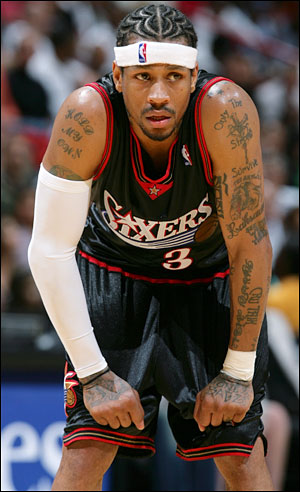
So what was it about Dennis Rodman that made him a 'role model' in my eyes? Well #1: he was a hell of a basketball player and I had been playing basketball since I was 6 so I respected that. #2 and most importantly: he wasn't afraid to be who he was--he stepped out covered in tattoos with a different color of hair each week and killed it on the court (you must remember that heavily tattooed basketball players were rare in the 90s, unlike today when you have dudes like Allen Iverson and Chris Anderson among countless others). Off the court he partied hardcore and did drugs, but I tended to ignore that side of him because I was only interested in who he was on the court. Whether what I saw as positive role model traits actually existed in who he was and how he represented himself, it didn't cause me to be a bad person or kid--I didn't drop out of school or start drinking and partying heavily, or anything like that (though I am heavily tattooed but I wouldn't attribute the motivation for that to Dennis). Basically, I think it came down to me being realistic about who he was both on and off the court and simply choosing to admire what I saw were the good traits that he had to offer.
Before I had seen the actual apology, I had run across this Bloggingheads video (part of the Opinion section in the NYTimes Online) which discusses Tiger's apology and it's affect on kids. One question that came up was whether or not kids should have role models who are famous sports stars, actors/actresses, musicians, etc.
What do you think? Personally or as a librarian or both! If we encourage kids to interact with various media then we must also expect that they will be influenced by or have opinions about the people they encounter in those various types of media.
Growing up, Dennis Rodman was my role model. My room was covered in Chicago Bulls posters, pictures cut out from Sports Illustrated and other sports magazines, and even a life size stand up of Rodman in action (I'm sure you guys are getting an 'interesting' perspective into who I am from the nature of my recent posts ha-ha!). I went down to our local and very small bookstore when his book Bad as I wanna be came out and was turned away because the book peddler didn't think it was an appropriate book for a 13 year old girl to be reading (little did she know I just turned around and bought it somewhere else!).
So what was it about Dennis Rodman that made him a 'role model' in my eyes? Well #1: he was a hell of a basketball player and I had been playing basketball since I was 6 so I respected that. #2 and most importantly: he wasn't afraid to be who he was--he stepped out covered in tattoos with a different color of hair each week and killed it on the court (you must remember that heavily tattooed basketball players were rare in the 90s, unlike today when you have dudes like Allen Iverson and Chris Anderson among countless others). Off the court he partied hardcore and did drugs, but I tended to ignore that side of him because I was only interested in who he was on the court. Whether what I saw as positive role model traits actually existed in who he was and how he represented himself, it didn't cause me to be a bad person or kid--I didn't drop out of school or start drinking and partying heavily, or anything like that (though I am heavily tattooed but I wouldn't attribute the motivation for that to Dennis). Basically, I think it came down to me being realistic about who he was both on and off the court and simply choosing to admire what I saw were the good traits that he had to offer.
Wednesday, February 24, 2010
Adam Haslet interview
This morning, on my way to work, I was listening to NPR, http://www.npr.org/templates/story/story.php?storyId=123542128, and Morning Edition. They were running an interview with a first time novelist, Adam Haslet. His book, Union Atlantic, has just arrived on the bookstore shelves.
Most of the interview was only mildly interesting, mostly because his novel, written and sent off to the publisher, before the collapse of the large banks in 2008, is about just that – the collapse and possible bailout of a major bank in the US and the implication to America’s economic system if it is allowed to fail.
However, what really caught my ear was when the interview turned to human nature, culture and fiction.
"The world is so insanely complex and fast and distracting, and one of the things I think a good book can do is slow the reader's attention down a little bit and give them a chance to think through some of the consequences of these changes which otherwise are so quick that all you can do is react," Haslett says.
So is literature the answer?
"It's an ameliorative," Haslett says with a laugh. "I don't think it's an answer, I don't think it will solve our problems but I think how we pay attention to the world matters and if you can spend time inside an imaginative world then there's a calmness and an ability to think.”
That is what caught my attention. That is exactly why I love realistic fiction. It allows me to slow down, escape for a short while from my too busy life – school, work, son’s wedding, and think about someone else’s life. But it isn’t total escapism. I am drawn into someone else’s life but then invited to stop and think of how this would play out in real life. What would I do in such a situation? There is a certain freedom in the fact that it is make believe and yet, realistic enough to draw me in and make me think.
That would not be the case with fantasy fiction, for me. I have not been able to identify with the characters in fantasy – at least not yet – and that is an important ingredient of the enjoyment for me.
This can also be said of film or, video. A good fiction played out on the screen allows me to get lost in it, leave my world behind for a time and live in someone else’s but at the same time allows me to slow down enough to think and feel, just like a book.
Film and video, however, bring another element to fiction, as we learned this week. The scene, characters, and sounds are not left up to our imagination as much as I thought. We still need imagination to suspend our lives for awhile and become one of the characters, but we are provided many of the details by the director who puts all of this together. As the short video in our study guide suggests, Mise-en-Scene, if well planned, can bring another element to our viewing.
So, I learned tonight that I think I react viscerally to good realistic fiction because of my interpersonal nature. And, I still think that is true to a certain extent; I agree with Haslet, in that. Additionally, I think, as does Haslet, that good realistic fiction can slow us down and make us think about our world, how and where we fit in it. However, I now know that many of my visceral reactions are there because of the staging of the director, cinematographer, sound man and costume designer. Somehow, that is not quite as romantic!
Most of the interview was only mildly interesting, mostly because his novel, written and sent off to the publisher, before the collapse of the large banks in 2008, is about just that – the collapse and possible bailout of a major bank in the US and the implication to America’s economic system if it is allowed to fail.
However, what really caught my ear was when the interview turned to human nature, culture and fiction.
"The world is so insanely complex and fast and distracting, and one of the things I think a good book can do is slow the reader's attention down a little bit and give them a chance to think through some of the consequences of these changes which otherwise are so quick that all you can do is react," Haslett says.
So is literature the answer?
"It's an ameliorative," Haslett says with a laugh. "I don't think it's an answer, I don't think it will solve our problems but I think how we pay attention to the world matters and if you can spend time inside an imaginative world then there's a calmness and an ability to think.”
That is what caught my attention. That is exactly why I love realistic fiction. It allows me to slow down, escape for a short while from my too busy life – school, work, son’s wedding, and think about someone else’s life. But it isn’t total escapism. I am drawn into someone else’s life but then invited to stop and think of how this would play out in real life. What would I do in such a situation? There is a certain freedom in the fact that it is make believe and yet, realistic enough to draw me in and make me think.
That would not be the case with fantasy fiction, for me. I have not been able to identify with the characters in fantasy – at least not yet – and that is an important ingredient of the enjoyment for me.
This can also be said of film or, video. A good fiction played out on the screen allows me to get lost in it, leave my world behind for a time and live in someone else’s but at the same time allows me to slow down enough to think and feel, just like a book.
Film and video, however, bring another element to fiction, as we learned this week. The scene, characters, and sounds are not left up to our imagination as much as I thought. We still need imagination to suspend our lives for awhile and become one of the characters, but we are provided many of the details by the director who puts all of this together. As the short video in our study guide suggests, Mise-en-Scene, if well planned, can bring another element to our viewing.
So, I learned tonight that I think I react viscerally to good realistic fiction because of my interpersonal nature. And, I still think that is true to a certain extent; I agree with Haslet, in that. Additionally, I think, as does Haslet, that good realistic fiction can slow us down and make us think about our world, how and where we fit in it. However, I now know that many of my visceral reactions are there because of the staging of the director, cinematographer, sound man and costume designer. Somehow, that is not quite as romantic!
More Information
A frightening development from ideas like the one we discussed on this post: a school in PA is accused of using the webcams installed in students' school-issued laptops to spy on them at home. (that link will take you to a list of articles that includes statements from teachers/principals and some of the trial details)
Teen Tech Week
I got a link to this article in my latest ALA Direct e-mail, and thought it was especially fitting for our topics! From In the Library With the Lead Pipe (a blog I've just discovered but am looking forward to browsing through a bit more!):
Teen Tech Week is held from March 7-13 this year. For those of you who haven't held or participated in this event (myself included), and are planning on working with youth, it might be worth a gander at the ALA/YALSA site for the week (that's the link under TTW up there). There are program ideas and resources, publicity tools, and a wiki, among other things.
And as Robyn Vittek, the author of the article, says, there is little to criticize about Teen Tech Week. It's an initiative to get teens into the library in an interactive way, as well as a push for librarians to find new and exciting ways to integrate technology into their youth programs. Ideally, a YA librarian would be doing this anyway, but especially in libraries with smaller staffs and budgets, it can be difficult. This initiative is
From her conclusion:
"One of the newest national initiatives, Teen Tech Week has been celebrated by ALA’s Young Adult Library Services Association (YALSA) since 2007. This year, Teen Tech Week is March 7–13. According to the YALSA website, “The purpose of the initiative is to ensure that teens are competent and ethical users of technologies, especially those that are offered through libraries such as DVDs, databases, audiobooks, and videogames. Teen Tech Week encourages teens to use libraries’ nonprint resources for education and recreation, and to recognize that librarians are qualified, trusted professionals in the field of information technology.”1"
Teen Tech Week is held from March 7-13 this year. For those of you who haven't held or participated in this event (myself included), and are planning on working with youth, it might be worth a gander at the ALA/YALSA site for the week (that's the link under TTW up there). There are program ideas and resources, publicity tools, and a wiki, among other things.
And as Robyn Vittek, the author of the article, says, there is little to criticize about Teen Tech Week. It's an initiative to get teens into the library in an interactive way, as well as a push for librarians to find new and exciting ways to integrate technology into their youth programs. Ideally, a YA librarian would be doing this anyway, but especially in libraries with smaller staffs and budgets, it can be difficult. This initiative is
From her conclusion:
"The exciting thing about Teen Tech Week is that it gives us an opportunity to explore and learn to use all of the websites, gadgets, and formats that our library is purchasing, our teens are bringing into the building, and we are reading about in professional journals and magazines. It is a chance to let the teens know that libraries and librarians are not all about books. We are interested in learning about and sharing all types of information resources, and prove entertaining and cutting edge programming and services that occasionally dip into the philanthropic or even (gasp!) educational arenas. When you choose to participate in Teen Tech Week, it’s not only the teens who “Create, Share and Learn @ your Library.” The staff will as well."
On a life spent illegally downloading music
I remember the first time I used Napster. I was in ninth grade, spending the night at my friend Lindsey's house. "Listen to this," she said. She had downloaded a dozen or so songs by a band I'd never heard of, called Dashboard Confessional. (I thought the singer was a woman.) My family, devoted Macintosh users all, didn't have access to Napster (much less a CD burner or a sufficiently fast internet connection, even in the dialup days) - Lindsey's new toy was a revelation. We spent the entire night downloading music, one song at a time. By the next morning, we had downloaded four songs. Awesome.
By the time I got to college, things were in even better shape for the young and broke. My college unwittingly played host to "the network" - thousands and thousands of movies, games, television episodes, and songs shared among every student on campus. Some particularly industrious hosts held close to a terabyte of stuff all by themselves. Others prided themselves on having new TV episodes up and available within hours of their airing. Nobody had cable or Netflix, and only a handful of us patronized the super-cool record store downtown.
So I'm one of those people - a child of the digital generation who downloads music illegally without a second thought. Kind of. Like a lot of people my age - mid-twenties-ish - I still spend plenty of money on my music consumption. The difference is that I spend most of it on concerts and T-shirts. I still buy music. I paid $5 for that Radiohead album a couple of years ago, because that's how much a Radiohead album that isn't Kid A is worth to me. Last week I downloaded James Mercer's side project, but I'll probably pay money for it when it comes out in March.
"But those aren’t baby bands who had to do it themselves from the start. Newer acts may well be cottage industries — in wired cottages — for life." (NYT)
Sure, when I see a good local band at a bar or club, I buy their CD - but that doesn't happen too often. For one thing, I am not hip enough to go out three times a week. For another, most local bands are pretty terrible. Most of the music I listen to I heard on TV or the radio - same as ever. The difference is that if I hear a song I like - on a TV show, on the radio, whatever - I go online and download it for free. But what's changed, really? As a kid, I taped songs off of the radio all the time. The difference is that now, there is way more out there to download, right? Thanks to the internet, every whosit with a guitar has a chance at fame! If anyone ever hears it. I totally thought that the whole MySpace music thing was going to change the world, but it hasn't. The tastemakers are the same people, but now they're in worse financial shape than ever, so they're promoting even fewer artists.
So, unless you're really good at marketing yourself - or unless your label (if you have one!) thinks you're The Next Big Thing - you're basically screwed. Sure, you can buy my friend's band's CD on iTunes, but does anyone? (I did, Noah!) Sure, Radiohead's stunt worked, but that's because they're Radiohead. And I notice, with the kids I work with, that everything they listen to is manufactured. The younger kids and the 'tween set listen to Disney popsters and Taylor Swift, the teens are into whatever rap guy is big at the moment. There's way too much garbage out there for us to become our own tastemakers. And so the world is basically unchanged. There was no MySpace revolution. The pool of what we actually listen to has only gotten smaller. Other than the occasional tidbit on NPR or tiny college radio stations, when is the last time you heard independent music on the radio?
"But the flip side of disintermediation — not having to rely on any middleman for approval or distribution — is a near-infinite slush pile. All the filtering that used to take place out of earshot, in A&R and club bookers’ offices, can be bypassed." (NYT)
ON THE OTHER HAND! There are artists that succeed - that have gotten their "break" on YouTube or MySpace. Not many of them, but it does happen. I do know a handful of teens - again, not many, but a few - who are into making mash-ups, filming their own music videos for their favorite songs and putting them on YouTube, and tweeting to (with?) their favorite artists. None of this could have happened before the internet. The music industry has changed, but it's not the artist who suddenly has power. It's the consumer. Much like we see in television - with fan movements bringing back cancelled shows (Chuck, Jericho), fanfiction writers re-writing plot points for their fellow fans, and consumers making choices about how they want to watch their favorite shows (TiVo, Hulu, BitTorrent) - listeners are now better equipped than ever to listen to music the way they want to. Pay for it, steal it, interact with it. For the first time, we can dig through that slush pile ourselves if we want to. There are countless websites that can direct you to the good stuff, most of them run by random people out in the world - not the record execs. Not Simon Cowell.
It's not a revolution. Our music tastes, as a culture, haven't suddenly diversified. Most of us still listen to whatever the record companies put on the table. But we don't have to. And that's pretty cool.
P.S. PBS: It's Sarah McLachlan. With an H.
Interesting: http://www.guardian.co.uk/music/musicblog/2009/jan/08/long-tail-myth-download
On another, TOTALLY NSFW note, this blog.
If you didn't get enough inane and/or deeply offensive rap lyrics from that PBS site, I recommend you check this out. Commentary ranges from seriously hilarious to roughly as offensive as the lyrics, but whatever. Also, does anyone else look back fondly on the days when "Drake" was Jimmy Brooks on Degrassi? And can we just take a minute to note how totally not gangster Degrassi is?
By the time I got to college, things were in even better shape for the young and broke. My college unwittingly played host to "the network" - thousands and thousands of movies, games, television episodes, and songs shared among every student on campus. Some particularly industrious hosts held close to a terabyte of stuff all by themselves. Others prided themselves on having new TV episodes up and available within hours of their airing. Nobody had cable or Netflix, and only a handful of us patronized the super-cool record store downtown.
So I'm one of those people - a child of the digital generation who downloads music illegally without a second thought. Kind of. Like a lot of people my age - mid-twenties-ish - I still spend plenty of money on my music consumption. The difference is that I spend most of it on concerts and T-shirts. I still buy music. I paid $5 for that Radiohead album a couple of years ago, because that's how much a Radiohead album that isn't Kid A is worth to me. Last week I downloaded James Mercer's side project, but I'll probably pay money for it when it comes out in March.
"But those aren’t baby bands who had to do it themselves from the start. Newer acts may well be cottage industries — in wired cottages — for life." (NYT)
Sure, when I see a good local band at a bar or club, I buy their CD - but that doesn't happen too often. For one thing, I am not hip enough to go out three times a week. For another, most local bands are pretty terrible. Most of the music I listen to I heard on TV or the radio - same as ever. The difference is that if I hear a song I like - on a TV show, on the radio, whatever - I go online and download it for free. But what's changed, really? As a kid, I taped songs off of the radio all the time. The difference is that now, there is way more out there to download, right? Thanks to the internet, every whosit with a guitar has a chance at fame! If anyone ever hears it. I totally thought that the whole MySpace music thing was going to change the world, but it hasn't. The tastemakers are the same people, but now they're in worse financial shape than ever, so they're promoting even fewer artists.
So, unless you're really good at marketing yourself - or unless your label (if you have one!) thinks you're The Next Big Thing - you're basically screwed. Sure, you can buy my friend's band's CD on iTunes, but does anyone? (I did, Noah!) Sure, Radiohead's stunt worked, but that's because they're Radiohead. And I notice, with the kids I work with, that everything they listen to is manufactured. The younger kids and the 'tween set listen to Disney popsters and Taylor Swift, the teens are into whatever rap guy is big at the moment. There's way too much garbage out there for us to become our own tastemakers. And so the world is basically unchanged. There was no MySpace revolution. The pool of what we actually listen to has only gotten smaller. Other than the occasional tidbit on NPR or tiny college radio stations, when is the last time you heard independent music on the radio?
"But the flip side of disintermediation — not having to rely on any middleman for approval or distribution — is a near-infinite slush pile. All the filtering that used to take place out of earshot, in A&R and club bookers’ offices, can be bypassed." (NYT)
ON THE OTHER HAND! There are artists that succeed - that have gotten their "break" on YouTube or MySpace. Not many of them, but it does happen. I do know a handful of teens - again, not many, but a few - who are into making mash-ups, filming their own music videos for their favorite songs and putting them on YouTube, and tweeting to (with?) their favorite artists. None of this could have happened before the internet. The music industry has changed, but it's not the artist who suddenly has power. It's the consumer. Much like we see in television - with fan movements bringing back cancelled shows (Chuck, Jericho), fanfiction writers re-writing plot points for their fellow fans, and consumers making choices about how they want to watch their favorite shows (TiVo, Hulu, BitTorrent) - listeners are now better equipped than ever to listen to music the way they want to. Pay for it, steal it, interact with it. For the first time, we can dig through that slush pile ourselves if we want to. There are countless websites that can direct you to the good stuff, most of them run by random people out in the world - not the record execs. Not Simon Cowell.
It's not a revolution. Our music tastes, as a culture, haven't suddenly diversified. Most of us still listen to whatever the record companies put on the table. But we don't have to. And that's pretty cool.
P.S. PBS: It's Sarah McLachlan. With an H.
Interesting: http://www.guardian.co.uk/music/musicblog/2009/jan/08/long-tail-myth-download
On another, TOTALLY NSFW note, this blog.
If you didn't get enough inane and/or deeply offensive rap lyrics from that PBS site, I recommend you check this out. Commentary ranges from seriously hilarious to roughly as offensive as the lyrics, but whatever. Also, does anyone else look back fondly on the days when "Drake" was Jimmy Brooks on Degrassi? And can we just take a minute to note how totally not gangster Degrassi is?
Monday, February 22, 2010
The personal importance of lyrics . . .
This comment was too long to fit in the comment box as a response to Sue's "Same Old Same Old? or a Whole New World?" post, so I was forced to post it separately.
Sue wrote: "And yet, some things are very different than they were. I used to have to listen to a song over and over and over again to try and figure out what the lyrics were. There were endless debates: did he say “Rolled up like a deuce” or “Rolled up like a douche”? (How sophisticated we thought we were to be able to say that work without giggling…) Nowadays, the lyrics are there for you with a click if you want them. I’m not entirely sure why that seems important to me, but it does. I’d welcome others’ thoughts on whether this instant availability of the lyrics matters."
Personally, knowing that lyrics are instantly available (whether you actually use them or not) has been and is somewhat important to me: I'm a fan and frequenter of Lyrics on Demand. Because I came to exist when I did (1983) and started getting into music at a time (early 90's) when lyrics were made readily available in the booklets included in the cases of tapes and CDs (and now as .pdf files when you download an entire album through iTunes), I've never known a time when lyrics weren't at my finger tips and thus have always been able to access and use them in different ways. Before I explain how I use lyrics and why they were and continue to be important to me, I should mention that lyrics were usually available for music that was current and popular (on tapes and CDs) while I was going up, but not necessarily for music prior to the advent of the tape and CD, though not all tapes and CDs guaranteed the inclusion of lyrics. That didn't matter to me when I was a teenager because I didn't really care about music that wasn't popular during that time, but it became increasingly important as I grew older, gained more interest in older music, and wanted to engage with the lyrics more intimately.
I grew up in rural southern Colorado, a half Mexican, half Swedish only child listening to a slue of random music that sometimes seemed to have a place in my life and sometimes didn't. My dad listened to the following: Tejano/Ranchero music out of New Mexico and Texas, traditional Mexican folk music, disco, 80's hits, country (early George Strait, Randy Travis, Reba McEntire, Hank Williams Jr.) and what was then starting to become 'older country' (Merle Haggard, Hank Williams, Johnny Cash, Waylon Jennings). My mom, on the other hand, listened to Oldies (40's through 60's), what is now considered Classic Rock (Beatles, Bachman-Turner Overdrive, Tom Petty and the Heartbreakers, CCR, etc) and 70's & 80's hits.
While I was and still am heavily influenced by and enjoy all of these different genres of music, when I was a teenager, the last thing I was going to be associated with was anything that my parents listened to: their music was lame, the lyrics didn't speak to me, and I couldn't relate to words or the music. Instead I was deeply interested in and loved Hip Hop and Rap music. In middle school I was breakin' and jammim' to Hip Hop from MC Hammer, Slick Rick, 2 Live Crew, Outkast, Warren G, and Salt -N- Pepa. As I got 'older' and moved into high school, I got over Hip Hop and became obsessed with Gangsta Rap from rappers including The Wu Tang Clan, Snoop Dogg, Dr. Dre, The Notorious B.I.G, Tupac, and The Big Tymers.
I was drawn to Hip Hop and Rap because not only was it 'cool' but the sound was one of a kind: the beat rattled my soul, the words penetrated my brain, and the bass stopped my heart. I prided myself on being able to know the words by heart and rap along to the song with my friends. It was fun and rebellious to give my birthday and Christmas money to my friend's older brother so that he could buy me the explicit lyric Rap CDs that my parents forbid me to buy and listen to (they lived in a shoe box in the back of my closet). But given my background and upbringing, which was pretty 'white picket fence' in my opinion, I couldn't and didn't personally relate to the content of the music, but for some reason it moved and inspired me and I was addicted.
Whether the music was bumpin in my car, on my stereo in my room, or through my Discman's headphones into my ears and directly into my cerebral cortex, I could usually always hear the lyrics clearly and understand them, but this wasn't always the case: sometimes the beat was so sick that I was too distracted to hear what the rapper was saying or I only payed attention to certain verses in the song because they were catchy or were my favorite part of the song. Of course situations like this made having the lyrics convenient to consult to clear up ambiguity or to focus on parts of the song that didn't jump out.
But they also went above and beyond that purpose for me: they were poetry when read alone, they were a guide that allowed you to read along and listen closely to the music and experience it in a way different from just listening without them. I could hear the song and enjoy it and I could read the lyrics of the song and understand the message or get the meaning, but listening to the music and reading the lyrics simultaneously brought it all together and could elicit deeper feelings, understanding, and emotions, especially when done through headphones. The beat and melody transported me to another world and the words became more than words, they became truth.
Like other Hip Hop and Rap fans from my generation, I have lost interest and respect in the current direction that Hip Hop and Rap has taken in the modern industry. I yearn for raps and beats from 'back in the day' when there was something to be said, real messages to be delivered, and lyrics worth listening to. Although in my opinion the content/message of songs and the lyrics found in most mainstream music today isn't as poetic or deep as it used to be, having access to lyrics in any form is convenient and can be both enjoyable and meaningful for teenagers or anyone.
Sue wrote: "And yet, some things are very different than they were. I used to have to listen to a song over and over and over again to try and figure out what the lyrics were. There were endless debates: did he say “Rolled up like a deuce” or “Rolled up like a douche”? (How sophisticated we thought we were to be able to say that work without giggling…) Nowadays, the lyrics are there for you with a click if you want them. I’m not entirely sure why that seems important to me, but it does. I’d welcome others’ thoughts on whether this instant availability of the lyrics matters."
Personally, knowing that lyrics are instantly available (whether you actually use them or not) has been and is somewhat important to me: I'm a fan and frequenter of Lyrics on Demand. Because I came to exist when I did (1983) and started getting into music at a time (early 90's) when lyrics were made readily available in the booklets included in the cases of tapes and CDs (and now as .pdf files when you download an entire album through iTunes), I've never known a time when lyrics weren't at my finger tips and thus have always been able to access and use them in different ways. Before I explain how I use lyrics and why they were and continue to be important to me, I should mention that lyrics were usually available for music that was current and popular (on tapes and CDs) while I was going up, but not necessarily for music prior to the advent of the tape and CD, though not all tapes and CDs guaranteed the inclusion of lyrics. That didn't matter to me when I was a teenager because I didn't really care about music that wasn't popular during that time, but it became increasingly important as I grew older, gained more interest in older music, and wanted to engage with the lyrics more intimately.
I grew up in rural southern Colorado, a half Mexican, half Swedish only child listening to a slue of random music that sometimes seemed to have a place in my life and sometimes didn't. My dad listened to the following: Tejano/Ranchero music out of New Mexico and Texas, traditional Mexican folk music, disco, 80's hits, country (early George Strait, Randy Travis, Reba McEntire, Hank Williams Jr.) and what was then starting to become 'older country' (Merle Haggard, Hank Williams, Johnny Cash, Waylon Jennings). My mom, on the other hand, listened to Oldies (40's through 60's), what is now considered Classic Rock (Beatles, Bachman-Turner Overdrive, Tom Petty and the Heartbreakers, CCR, etc) and 70's & 80's hits.
While I was and still am heavily influenced by and enjoy all of these different genres of music, when I was a teenager, the last thing I was going to be associated with was anything that my parents listened to: their music was lame, the lyrics didn't speak to me, and I couldn't relate to words or the music. Instead I was deeply interested in and loved Hip Hop and Rap music. In middle school I was breakin' and jammim' to Hip Hop from MC Hammer, Slick Rick, 2 Live Crew, Outkast, Warren G, and Salt -N- Pepa. As I got 'older' and moved into high school, I got over Hip Hop and became obsessed with Gangsta Rap from rappers including The Wu Tang Clan, Snoop Dogg, Dr. Dre, The Notorious B.I.G, Tupac, and The Big Tymers.
I was drawn to Hip Hop and Rap because not only was it 'cool' but the sound was one of a kind: the beat rattled my soul, the words penetrated my brain, and the bass stopped my heart. I prided myself on being able to know the words by heart and rap along to the song with my friends. It was fun and rebellious to give my birthday and Christmas money to my friend's older brother so that he could buy me the explicit lyric Rap CDs that my parents forbid me to buy and listen to (they lived in a shoe box in the back of my closet). But given my background and upbringing, which was pretty 'white picket fence' in my opinion, I couldn't and didn't personally relate to the content of the music, but for some reason it moved and inspired me and I was addicted.
Whether the music was bumpin in my car, on my stereo in my room, or through my Discman's headphones into my ears and directly into my cerebral cortex, I could usually always hear the lyrics clearly and understand them, but this wasn't always the case: sometimes the beat was so sick that I was too distracted to hear what the rapper was saying or I only payed attention to certain verses in the song because they were catchy or were my favorite part of the song. Of course situations like this made having the lyrics convenient to consult to clear up ambiguity or to focus on parts of the song that didn't jump out.
But they also went above and beyond that purpose for me: they were poetry when read alone, they were a guide that allowed you to read along and listen closely to the music and experience it in a way different from just listening without them. I could hear the song and enjoy it and I could read the lyrics of the song and understand the message or get the meaning, but listening to the music and reading the lyrics simultaneously brought it all together and could elicit deeper feelings, understanding, and emotions, especially when done through headphones. The beat and melody transported me to another world and the words became more than words, they became truth.
Like other Hip Hop and Rap fans from my generation, I have lost interest and respect in the current direction that Hip Hop and Rap has taken in the modern industry. I yearn for raps and beats from 'back in the day' when there was something to be said, real messages to be delivered, and lyrics worth listening to. Although in my opinion the content/message of songs and the lyrics found in most mainstream music today isn't as poetic or deep as it used to be, having access to lyrics in any form is convenient and can be both enjoyable and meaningful for teenagers or anyone.
Thursday, February 18, 2010
the times are a changin'
The changes to sound recordings over recent years is truly amazing. The Way the Music Died piece was helpful in understanding some of the changes from insiders’ views and even though this production for PBS’ Frontline program was made in 2004, many of the trends the artists discussed continue today. Since this program was made mp3 players and iPods have exploded into such a pervasive part of our society and I believe this was mentioned in our session last night for class. This program in particular made me think about my time working at the Bloomington Public Library (IL) and how music cds were such a huge collection seemingly when I began working there in 2001 and how they began to decline in numbers overall and in new titles as I was about to leave there in 2007. Since that time the collections only gotten sparser it seems. The number of audio books on cd has diminished likewise in a similar pattern which stinks for me as I had only just figured out how to use My Media Mall last summer when Bloomington and others in the library system got rid of it. Now I have to find new reads from this limited format there. I was ready to make the technology leap and the rug got pulled out from under me! I think many patrons like myself in public libraries will have to adapt likewise as it’s more feasible to have services like My Media Mall than cds and other physical formats. I wonder whether music collections at public libraries will dwindle to nothing with so many using services like iTunes, Rhapsody, and the like. In schools, especially in this cash strapped state, I imagine audio books on tape or cd will have longer lives but even in this library setting mp3 audio books like Playaways are making in-roads.
Media Literacy and Criminals
I know that this course is about youth and media literacy, but I've been quite amused recently about the articles that I have been coming across concerning criminals and their use of new media and games.
Gaming, for instance, seems to be greatly misunderstood. The article about Dungeons and Dragons that I have posted above is a bit problematic for me. I suppose if one is in prison, then they are being punished for some reason and shouldn't be able to do everything. On the other hand, I don't know that I agree that Dungeons and Dragons "promotes fantasy role playing, competitive hostility, violence, addictive escape behaviors, and possible gambling." Statements like that lead me to believe that there is an air of ignorance towards gaming that needs to be addressed in our criminal justice system.
With all of this being said, I have found these articles quite interesting. Our focus on youth in this course is not wholly separate for these topics. Informing young people about new media and gaming is important, but it's also important to teach them about being responsible with new media and making them aware that the choices that they make about what to share and post online are choices that need to be taken seriously. A new site has been created called Please Rob Me that simply searches for public Twitter posts in which people freely mention that they have left home. This information can be combined with other location-based social networking tools to determine the location of homes that have been left unoccupied. I'm sure most of us don't think about that when we post status messages about our locations, but it's perhaps something that we should be thinking about and it's a great example of a seemingly simple action that has rather unintended consequences.
- Gangs use of Twitter, Facebook on the rise
- Criminal Colin Gunn Used Facebook To Threaten Enemies From Jail
- Dungeons and Dragons Prison Ban Upheld
- Fugitive Christopher Crego Posts Facebook Info That Helps Police Arrest Him
- Prisoners Lose Facebook Pages After Victim Taunts
Gaming, for instance, seems to be greatly misunderstood. The article about Dungeons and Dragons that I have posted above is a bit problematic for me. I suppose if one is in prison, then they are being punished for some reason and shouldn't be able to do everything. On the other hand, I don't know that I agree that Dungeons and Dragons "promotes fantasy role playing, competitive hostility, violence, addictive escape behaviors, and possible gambling." Statements like that lead me to believe that there is an air of ignorance towards gaming that needs to be addressed in our criminal justice system.
With all of this being said, I have found these articles quite interesting. Our focus on youth in this course is not wholly separate for these topics. Informing young people about new media and gaming is important, but it's also important to teach them about being responsible with new media and making them aware that the choices that they make about what to share and post online are choices that need to be taken seriously. A new site has been created called Please Rob Me that simply searches for public Twitter posts in which people freely mention that they have left home. This information can be combined with other location-based social networking tools to determine the location of homes that have been left unoccupied. I'm sure most of us don't think about that when we post status messages about our locations, but it's perhaps something that we should be thinking about and it's a great example of a seemingly simple action that has rather unintended consequences.
10 Technology Ideas Your Library Can Implement Next Week
From American Libraries, this article on easy technology tweaks offers up some good ideas for libraries of any size and flavor.
Wednesday, February 17, 2010
A History of Media Technology Scares, From the Printing Press to Facebook
Via LIS News and Slate:
"...Worries about information overload are as old as information itself, with each generation reimagining the dangerous impacts of technology on mind and brain. From a historical perspective, what strikes home is not the evolution of these social concerns, but their similarity from one century to the next, to the point where they arrive anew with little having changed except the label..."
Same Old Same Old? or A Whole New World?
While listening to Radio Disney this weekend, I was struck by how little things had changed since I was a tween and young teen, lo these many years ago. “I will love only you forever and ever.” “Love me for who I really am.” “I can’t live without your love.” “I’m really special inside where no-one can see.” “I’m for real, and I hate phonies” “You done me wrong.” “Baby, it feels so right when I’m with you.” And so it goes. Idealism, extreme emotions, high drama, focus on the self, and a deep desire to both fit in and be unique fill the songs that fill Radio Disney. These are the same themes that have been the hallmark of teen music for decades.
In addition to the music, much of the programming and promotion on Radio Disney had a very familiar feel to it. There were interviews with stars, contests—“Be the third caller and you could win…”—request lines, relentlessly upbeat disc jockeys, and young people on the phone trying very hard to sound very cool. Although I was trying to call the radio station from a Princess phone and today’s teens are calling from cell phones, the desire to be on the radio has not changed. Although my personal heartthrobs were Mark Lindsey and David Cassidy (much though I cringe to admit it) rather than the Jonas Brothers, the passionate adoration and desire to know every single possible detail about that person’s likes and dislikes are not very different today than they were when I was young.
And yet, some things are very different than they were. I used to have to listen to a song over and over and over again to try and figure out what the lyrics were. There were endless debates: did he say “Rolled up like a deuce” or “Rolled up like a douche”? (How sophisticated we thought we were to be able to say that work without giggling…) Nowadays, the lyrics are there for you with a click if you want them. I’m not entirely sure why that seems important to me, but it does. I’d welcome others’ thoughts on whether this instant availability of the lyrics matters.
When a radio station had a limited broadcast range it could only reach the people within its area of service. There was at least the possibility that popular songs or singers could vary from region to region. The capacity of Radio Disney to reach the whole nation instantly probably increases the homogeneity of popular music. The same songs and stars will be hits in New York, Chicago, Dallas and Los Angeles all at the same time.
Although there was some crossover between TV and music stars, i.e., David Cassidy, for the most part, music, movie and TV stars were different people. A musician followed one route to success and needed one particular set of people to back him or her, while a TV actor followed another route and needed a different set of people. The people who owned radio stations and music labels were not the same people who owned TV stations. But now, Miley Cyrus is a music/movie/TV juggernaut. Her TV show feeds demand for her music and her music and TV show promote her movies. Several of the songs I listened to this weekend were from the soundtrack of a soon to be released movie. There isn’t as much separation between entertainment venues as I remember.
I have heard it argued that the Internet would have a democratizing influence on music; anyone could get their music out there and find a following. Radio Disney seems to be an example of the opposite effect. By playing to young people’s desire to be on top of whatever is cool at the moment and being able to blitz the whole country with the few songs and singers that its owners deem to be marketable, Radio Disney has an enormously powerful effect on what tweens and teens listen to.
The idea of big corporations dictating what kind of music is available was also brought forth in the “Hip-Hop: Beyond Beats and Rhymes” and “The Way the Music Died” websites. This possibility bothers me a little less in those cases though, because they deal with music aimed more at adults. The argument that recording companies won’t buy hip-hop music with honorable or inspirational lyrics, that hip-hop musicians perform violent or homophobic songs because that is what sells has, in my opinion, some validity to it. If hundreds of thousands of people pay good money to buy songs with lyrics that I happen to think are hateful, it seems a little pointless to wring my hands and complain about the record companies or recording artists. As a society, we get the music we pay for, and if don’t like what is being paid for, we should probably think about why our culture values such songs.
Marketing to children though, may be a little different, simply because kids are developmentally more inclined to follow the herd. The need to fit in is so great at this age that it makes me a little uncomfortable to think of such a small group of people whose only motive is profit having such great influence. Having said that, though, I wonder what the solution would be. I would be very interested in knowing what others think about kids and music and marketing. Is anyone else troubled? Or am I over-reacting? Perhaps just another older person worrying needlessly about “young people these days?” In any event, spending time with Radio Disney was a very interesting and thought provoking experience.
In addition to the music, much of the programming and promotion on Radio Disney had a very familiar feel to it. There were interviews with stars, contests—“Be the third caller and you could win…”—request lines, relentlessly upbeat disc jockeys, and young people on the phone trying very hard to sound very cool. Although I was trying to call the radio station from a Princess phone and today’s teens are calling from cell phones, the desire to be on the radio has not changed. Although my personal heartthrobs were Mark Lindsey and David Cassidy (much though I cringe to admit it) rather than the Jonas Brothers, the passionate adoration and desire to know every single possible detail about that person’s likes and dislikes are not very different today than they were when I was young.
And yet, some things are very different than they were. I used to have to listen to a song over and over and over again to try and figure out what the lyrics were. There were endless debates: did he say “Rolled up like a deuce” or “Rolled up like a douche”? (How sophisticated we thought we were to be able to say that work without giggling…) Nowadays, the lyrics are there for you with a click if you want them. I’m not entirely sure why that seems important to me, but it does. I’d welcome others’ thoughts on whether this instant availability of the lyrics matters.
When a radio station had a limited broadcast range it could only reach the people within its area of service. There was at least the possibility that popular songs or singers could vary from region to region. The capacity of Radio Disney to reach the whole nation instantly probably increases the homogeneity of popular music. The same songs and stars will be hits in New York, Chicago, Dallas and Los Angeles all at the same time.
Although there was some crossover between TV and music stars, i.e., David Cassidy, for the most part, music, movie and TV stars were different people. A musician followed one route to success and needed one particular set of people to back him or her, while a TV actor followed another route and needed a different set of people. The people who owned radio stations and music labels were not the same people who owned TV stations. But now, Miley Cyrus is a music/movie/TV juggernaut. Her TV show feeds demand for her music and her music and TV show promote her movies. Several of the songs I listened to this weekend were from the soundtrack of a soon to be released movie. There isn’t as much separation between entertainment venues as I remember.
I have heard it argued that the Internet would have a democratizing influence on music; anyone could get their music out there and find a following. Radio Disney seems to be an example of the opposite effect. By playing to young people’s desire to be on top of whatever is cool at the moment and being able to blitz the whole country with the few songs and singers that its owners deem to be marketable, Radio Disney has an enormously powerful effect on what tweens and teens listen to.
The idea of big corporations dictating what kind of music is available was also brought forth in the “Hip-Hop: Beyond Beats and Rhymes” and “The Way the Music Died” websites. This possibility bothers me a little less in those cases though, because they deal with music aimed more at adults. The argument that recording companies won’t buy hip-hop music with honorable or inspirational lyrics, that hip-hop musicians perform violent or homophobic songs because that is what sells has, in my opinion, some validity to it. If hundreds of thousands of people pay good money to buy songs with lyrics that I happen to think are hateful, it seems a little pointless to wring my hands and complain about the record companies or recording artists. As a society, we get the music we pay for, and if don’t like what is being paid for, we should probably think about why our culture values such songs.
Marketing to children though, may be a little different, simply because kids are developmentally more inclined to follow the herd. The need to fit in is so great at this age that it makes me a little uncomfortable to think of such a small group of people whose only motive is profit having such great influence. Having said that, though, I wonder what the solution would be. I would be very interested in knowing what others think about kids and music and marketing. Is anyone else troubled? Or am I over-reacting? Perhaps just another older person worrying needlessly about “young people these days?” In any event, spending time with Radio Disney was a very interesting and thought provoking experience.
Tuesday, February 16, 2010
Free Information Visualization Tools
In class this past week, someone asked about building one's own visualizations. Here's a link to a post from FlowingData about a couple of free web-based tools to try out: http://bit.ly/9zOJLN
There are some tutorials on the FlowingData site (do a site search) that walk you through the process of creating some various visualizations, but most of them require knowledge of Python and basic scripting skills.
Cheers.
There are some tutorials on the FlowingData site (do a site search) that walk you through the process of creating some various visualizations, but most of them require knowledge of Python and basic scripting skills.
Cheers.
Friday, February 12, 2010
Images in the Classroom
A few years ago I was reflecting on how best to teach the African Slave Trade to my 9th grade world history students. While there are many different pedagogical approaches to teaching such disturbing and inhumane events and ideas to students, many of these methods require educators to use grade level or above readings and writing assignments. Certainly, these readings can be quite provocative and stimulate great discussion; however, I found that many of my students were so challenged by slave narratives and other primary and secondary documents that the full effect of the atrocities could not be felt. While that year many of my students had more life experience than me in terms of issues they dealt with on a daily basis they lacked the reading skills to match their maturity. For many educators this is certainly a problem—struggling readers with the ability to process complex and mature concepts and topics. As I brainstormed how best to take on this pedagogical challenge it led to reflection on how to best engage students in topics that are sometimes controversial, emotional, and unimaginable. The answer was clear—images.
As this week’s readings suggest, images are able to stimulate ideas and express meaning and stories. Further, they can encourage analysis and synthesis. For this particular lesson my goal was for students to understand:
1) the effects of European enslavement on the indigenous peoples of the Americas,
2) the role of African tribes in selling/trading slaves to Europeans,
3) the European conquest of African villages,
4) the experience of the Middle Passage including slave revolts and conditions aboard the slave ships, and
5) the arrival of the slave, the slave auction, and life on the plantation
To accomplish these goals I collected images of each part of the slave experience. Before presenting these images to the students we discussed the process of analyzing images and the power that an image can convey. After modeling an image analysis, students were organized into groups of three and given an envelope of images. The first task required students to place the images in order. During this phase, students were able to see the chronology of the experience and see the “big picture” of what had occurred. While this could have been done through a reading as well, being able to hold on to the pictures and creating a visual timeline for students made the ideas and events more tangible. Once students believed that the pictures were arranged in the appropriate order they articulated to me why the order that they had was correct. The next step required students to do an analysis of each image. This demanded students to look at particular details just as they would read for in a printed text. Students were encouraged to look for expression, types of weapons, clothing, etc. for each image in a step-by-step process. The end result was that students were able to breakdown each event/phase of the atrocity and talk about each with a strong sense of understanding. During the image analysis process students were also asked to develop discussion questions and write a list of questions to further inquiry to stimulate further exploration. The last phase of the lesson required students to take what they learned from the images and discussion and write a letter to slave.
Since I developed this lesson I have done it every year and found it incredibly successful. Students engage with the images and are able to create more connections than had I simply used slave narratives or other primary and secondary sources. The images encourage students to think critically and “see” history in front of them versus that of “reading” history. Since this activity I’ve had an increased appreciation for incorporating images in the classroom, especially when the topics lend themselves to challenging themes.
As this week’s readings suggest, images are able to stimulate ideas and express meaning and stories. Further, they can encourage analysis and synthesis. For this particular lesson my goal was for students to understand:
1) the effects of European enslavement on the indigenous peoples of the Americas,
2) the role of African tribes in selling/trading slaves to Europeans,
3) the European conquest of African villages,
4) the experience of the Middle Passage including slave revolts and conditions aboard the slave ships, and
5) the arrival of the slave, the slave auction, and life on the plantation
To accomplish these goals I collected images of each part of the slave experience. Before presenting these images to the students we discussed the process of analyzing images and the power that an image can convey. After modeling an image analysis, students were organized into groups of three and given an envelope of images. The first task required students to place the images in order. During this phase, students were able to see the chronology of the experience and see the “big picture” of what had occurred. While this could have been done through a reading as well, being able to hold on to the pictures and creating a visual timeline for students made the ideas and events more tangible. Once students believed that the pictures were arranged in the appropriate order they articulated to me why the order that they had was correct. The next step required students to do an analysis of each image. This demanded students to look at particular details just as they would read for in a printed text. Students were encouraged to look for expression, types of weapons, clothing, etc. for each image in a step-by-step process. The end result was that students were able to breakdown each event/phase of the atrocity and talk about each with a strong sense of understanding. During the image analysis process students were also asked to develop discussion questions and write a list of questions to further inquiry to stimulate further exploration. The last phase of the lesson required students to take what they learned from the images and discussion and write a letter to slave.
Since I developed this lesson I have done it every year and found it incredibly successful. Students engage with the images and are able to create more connections than had I simply used slave narratives or other primary and secondary sources. The images encourage students to think critically and “see” history in front of them versus that of “reading” history. Since this activity I’ve had an increased appreciation for incorporating images in the classroom, especially when the topics lend themselves to challenging themes.
Thursday, February 11, 2010
Do School Libraries Need Books?
As some of you may know, I'm not a GSLIS student. My current home department is the Computer Science department. I found this debate over at the New York Times on libraries interesting, and I would like to hear some of your comments on the topic. The debate concerns whether or not we still need physical books in libraries with, among other things, the increasing use of e-readers and the ever decreasing amount of books actually being checked out or browsed. I personally hate reading anything longer than a blog post on a screen and kill lots of trees printing things (I promise I print double-sided and with multiple sheets on each side of the page!), but I'm curious. What do some of you think?
Subscribe to:
Posts (Atom)


 Posts
Posts